
Have you ever felt a bit nervous about placing a trade? Technical analysis indicators are like a friendly guide that uses past price moves and trading volume to show you market trends. They work a bit like clues on a map, smoothing out what might feel like a bumpy ride in the market.
These tools mix simple math with the changing mood of the market to help you spot shifts early. In short, they offer a clearer view of the trading scene, which can boost your confidence when you decide to make a trade.
Functional Roles of Indicators in Technical Analysis
When you check out technical analysis indicators, you're really looking at math-based formulas drawn on price charts. They mix past data like price, volume, and open interest into signals that help you read market sentiment. For instance, a moving average line on a price chart doesn’t predict where prices will go; instead, it hints at trends by looking at past moves.
There are basically two kinds of indicators. First, overlay indicators, like moving averages, lay right on top of price charts to smooth out the ups and downs and spotlight the trend direction. Then you have oscillators, such as the RSI, which compare recent price points to tell you if something might be too pricey or too cheap. This simple breakdown can help you notice when market feelings are shifting.
Platforms like MetaTrader 4 come equipped with built-in tools that automatically calculate these indicators. This makes it a breeze to spot key support and resistance levels. Often, traders mix candlestick patterns with indicator signals to create a balanced strategy rather than relying on one single cue.
It’s important to remember that while these indicators offer useful market signals, they don't guarantee future price moves. Instead, think of them as guides based on past market behavior that can boost your confidence by highlighting potential shifts in trends.
Moving Average Indicators for Trend Detection
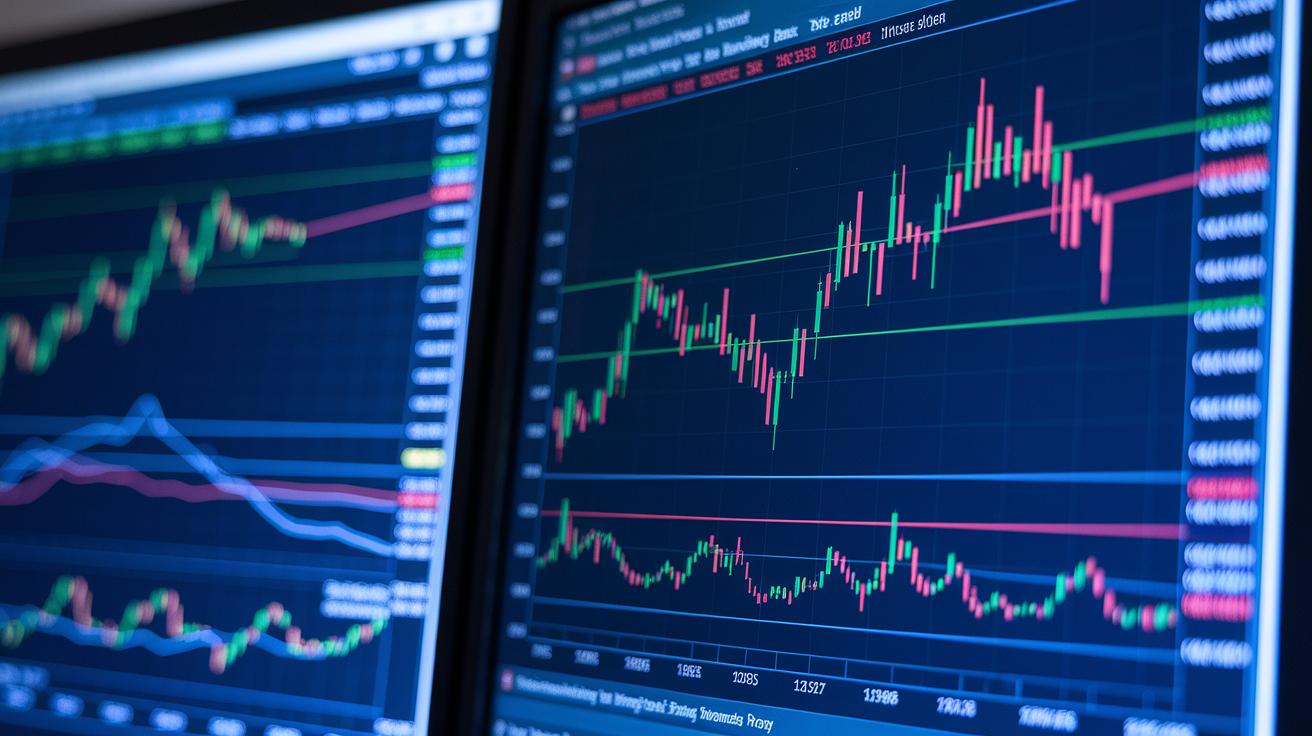
Moving average analysis helps clear up messy price charts by softening the daily ups and downs. It’s like smoothing out a bumpy road so you can see where things are headed.
One key tool is the Simple Moving Average (SMA). With the SMA, you add up prices over a set period, say, 12 days, and then divide by that number. This basic calculation gives you a straight-forward look at overall trends.
Another approach is the exponential average. This method puts extra weight on the most recent prices, making it quicker to pick up sudden shifts. You might hear traders mention the multiplier, which is calculated as 2 divided by (n+1), where n represents the number of days. Common timeframes are 20, 50, 100, or even 200 days.
There’s also the weighted mean method. In this case, each price is given a different level of importance, adding a new layer to trend spotting. Although it’s used less often, it can work well alongside the SMA and exponential average for a more detailed picture.
A major signal to watch for is when averages cross over. When a short-term average climbs above a long-term average, that “golden cross” can hint at a bullish market. Conversely, if the short-term average drops below the long-term one, a death cross, it may signal a downturn. Traders use these crossover signals as cues for when to enter or exit the market.
Momentum Indicators in Technical Analysis: RSI, MACD, and Oscillators
Developed back in the late 70s, the MACD is a type of momentum oscillator that measures the gap between a 12-period EMA and a 26-period EMA. It also comes with a 9-period signal line. When the MACD line moves up from below the signal line, it usually hints that it might be a good time to buy. But if it drops from above, that could be a sign to sell.
The RSI, or Relative Strength Index, works on a scale from 0 to 100 and tells us if an asset might be overbought or oversold. If the reading goes above 70, it may mean the asset is priced too high, while a score below 30 suggests you might be looking at a bargain. Introduced in 1978, this tool keeps things simple yet effective by breaking momentum down into everyday signals.
The Stochastic Oscillator is another useful tool that checks where the closing price falls within the recent high and low range. It gives you a percentage score that helps you see if the asset is leaning toward one end of that range. To smooth things out, the %D line averages the data, making it easier to spot potential turning points.
Then there’s the ADX, which measures how strong a trend is on a scale from 0 to 100. It comes with +DI and -DI lines to help indicate direction too. A high ADX reading tells you that the trend is strong, whether the price is rising or falling, adding a nice boost of confidence when you mix it with other signals.
| Indicator | Type | Default Parameters | Signal Interpretation |
|---|---|---|---|
| MACD | Momentum Oscillator | 12 EMA, 26 EMA, 9 Signal Line | Crossover from below suggests a buy; from above, a sell |
| RSI | Oscillator | 0-100 Scale | Above 70 overbought, below 30 oversold |
| Stochastic Oscillator | Price Action Oscillator | %K and %D lines | Indicates where closing price sits in high-low range |
| ADX | Trend Strength Indicator | 0-100 Scale with +DI and -DI | Higher readings suggest a stronger trend |
Volatility Indicators for Technical Analysis: Bollinger Bands and Standard Deviation

Bollinger Bands were created in the early 1980s. They work by taking a simple 20-period moving average and then placing an upper band and a lower band exactly two standard deviations away from that average. This setup helps you see if prices are trading in a normal range or if they are reaching extreme levels. When you see a stock touch the upper band, it can mean that heavy buying has pushed the price much higher than usual.
Percent-B tells you where the current price sits in relation to these bands, while Bandwidth shows you how wide the bands are compared to the moving average. A tightening of the bands may signal that a breakout is coming, much like noticing a coiled spring ready to release.
The Standard Deviation Indicator measures how spread out the price data is around its average. It does this by calculating the square root of the average of the squared differences between the price and the mean. This simple number shows you how dramatically prices are moving.
Using Bollinger Bands and Standard Deviation together gives traders a clear picture of when conditions might be ripe for a big move in the market.
- Band Squeeze Entry Techniques
- Volatility Breakout Confirmation
- Standard Deviation Threshold Alerts
Volume Indicators in Technical Analysis for Trend Confirmation
Volume indicators add a helpful layer of confidence to your trading decisions. They not only confirm price moves but also reveal hidden signals. For example, the VWAP (Volume Weighted Average Price) gives you an average price by dividing the total dollars traded by the total number of shares. This simple measure helps traders quickly see if the current price is above or below the day’s average, hinting at whether buyers or sellers are in control.
Then there’s OBV, or On-Balance Volume, which works by adding up volume on days when prices rise and subtracting it on down days. Imagine OBV steadily climbing even when the prices aren’t moving much; that could be a sign that buying pressure is building underneath the surface.
The Accumulation/Distribution line takes a slightly different route by linking volume with where the price sits in its daily range. If you notice the line rising while prices are falling, or falling while prices are rising, it might be a clue that the trend could soon reverse.
Lastly, the Price Volume Trend (PVT) refines OBV by multiplying the percentage change in price by the volume. This extra step gives a more detailed look at how price and volume work together, either backing up a trend or pointing out a potential mismatch.
Support and Resistance Indicators: Fibonacci and Pivot Points

Fibonacci retracements can be a handy tool for spotting where prices might bounce or turn around. Start by looking for a recent swing high and a swing low on your chart. Then, mark horizontal lines at the key levels of 23.6%, 38.2%, 50%, and 61.8%. These levels serve as signposts that hint where the price might reverse or continue its trend. For example, a trader might take notice if the price bounces at the 38.2% line, signaling a possible recovery.
Fibonacci Retracement
Begin by pinpointing your swing high and then work your way down to the swing low. Once you have those points, lay out the Fibonacci ratios along the way. These levels can guide you on where to set targets, exits, or stops if the market shifts suddenly. Just remember to tweak these levels as needed when the market shows different behavior.
Pivot Points
Pivot points are calculated by taking the average of the high, low, and close prices, just add them together and divide by 3. This average serves as the central pivot. From it, you can derive three support levels (S1 to S3) and three resistance levels (R1 to R3). Traders use these levels to spot potential breakouts or recoveries, especially on shorter timeframes. It’s a straightforward method that can really sharpen your trading decisions when the market mood changes.
technical analysis indicators: Boosting Trade Confidence
Using several technical indicators together can really boost your confidence when trading. It’s like getting a second opinion on your trade signals. Many traders like to mix one trend-filter tool, such as a moving average, with a momentum tool like the RSI or MACD. Adding a volume indicator like OBV shows that price moves have real support and aren’t just random fluctuations.
Keeping your chart clean by using only two to four matching indicators helps you focus on the important signals. Using both higher- and lower-timeframe charts to check these signals can make your entry and exit decisions even more reliable. For example, a strong buy signal might show up when the price is above the moving average, the RSI is climbing, and volume is picking up. On the flip side, if the indicators start to disagree or a key average gets breached, that might be your cue to exit.
Here are five simple rules to help mix these indicators effectively:
| Rule | Description |
|---|---|
| 1. Align indicators | Make sure trend and momentum indicators agree before you enter a trade. |
| 2. Confirm with volume | Look for volume spikes to back up breakouts. |
| 3. Use both types | Mix leading and lagging indicators to get better timing. |
| 4. Check multiple timeframes | Validate your signals on at least two different chart timeframes. |
| 5. Backtest | Run your ideas through history to see if they hold up over time. |
Combining these tools not only sharpens your view of the market but also reduces the chance of misreading a signal. Testing them over different market cycles reveals which combinations work best.
By sticking to these straightforward practices, you can build a trading strategy that blends indicator synthesis and paired indicator analysis. This way, you make sure your entry decisions and exit plans work together, all while benefiting from looking at multiple timeframes.
Final Words
In the action, we explored the building blocks of market insights. We covered how moving averages, momentum oscillators, and volatility measures shape our view of price behavior, while volume and support tools add clarity. We learned to blend technical analysis indicators with careful pairing to signal smart entries and exits. Using simple calculations based on real market data paves the way for more informed investment decisions. This combined approach offers a clear pathway toward steady financial growth.
FAQ
What does the technical analysis indicators PDF provide?
The technical analysis indicators PDF explains various market tools used on price charts, detailing how formulas process historical data like price and volume to signal potential trends while clarifying their role as guides, not predictors.
How can I get free technical analysis indicators?
The free technical analysis indicators are downloadable tools that many charting platforms offer. They provide basic overlays and oscillators to help spot trends without any cost and are great for starting your analysis.
What do the top 20 trading indicators include?
The top 20 trading indicators typically mix trend-following tools and momentum oscillators, such as moving averages, RSI, and MACD. They help traders assess market conditions and plan timely entries and exits.
What are the different types of technical analysis indicators?
The different technical analysis indicators include overlay indicators that draw on charts and oscillators that gauge momentum. They use past data to highlight market sentiment and aid in spotting potential trends or reversals.
Which technical analysis indicators are effective for forex trading?
The technical analysis indicators effective for forex trading often feature moving averages, oscillators like the RSI, and volume-based tools. They help monitor trend direction, identify reversals, and manage risk in the forex market.
Which platforms offer quality technical analysis indicators?
The quality technical analysis indicators are available on platforms such as TradingView, Binance, Robinhood, Webull, eToro, and Interactive Brokers LLC. They come with built-in charting tools that support decision-making in trading.